Teks Naratif
2026-10-07 09:19:38 WIB
Narrative Text
Narrative Text
(Teks Naratif)
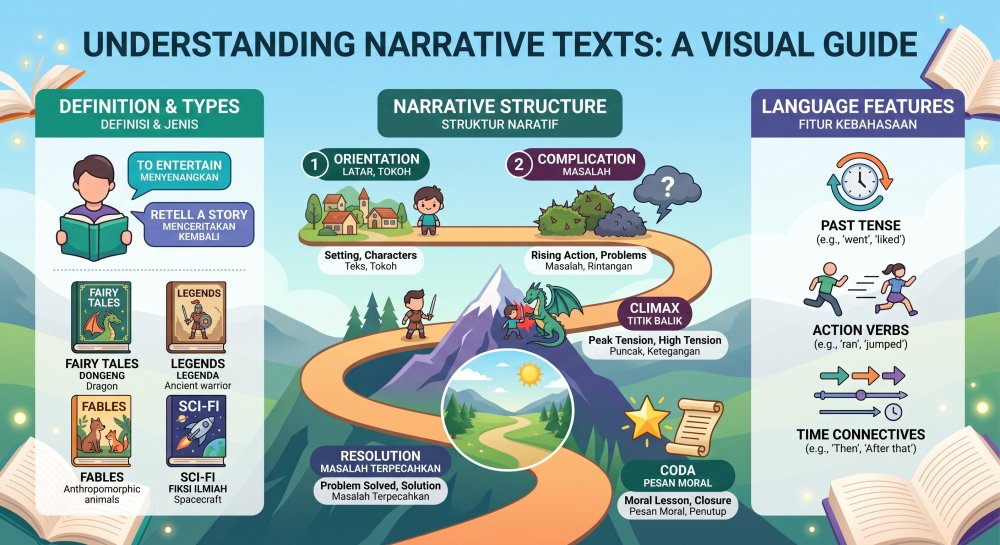
A Narrative Text is a type of text that tells a story, whether it's fictional, non-fictional, or a mix of both. It presents a series of events in a chronological sequence and usually involves a problem or conflict that needs to be resolved.
(Teks Naratif adalah jenis teks yang menceritakan sebuah kisah, baik itu fiksi, non-fiksi, atau campuran keduanya. Teks ini menyajikan serangkaian peristiwa dalam urutan kronologis dan biasanya melibatkan masalah atau konflik yang perlu diselesaikan.)
The main purpose of a narrative text is to entertain, amuse, or inform the reader.
(Tujuan utama dari teks naratif adalah untuk menghibur, menyenangkan, atau memberi informasi kepada pembaca.)
Types of Narrative Text
(Jenis-jenis Teks Naratif)
Narrative texts come in various forms, including:
(Teks naratif hadir dalam berbagai bentuk, termasuk:)
Fables: Stories involving animals that act like humans, often with a moral lesson (e.g., The Tortoise and the Hare).
(Fabel: Cerita yang melibatkan hewan yang bertingkah laku seperti manusia, seringkali dengan pesan moral. Contoh: Kelinci dan Kura-kura.)
Fairy Tales: Stories featuring magical creatures, enchantment, and often a "happily ever after" ending (e.g., Cinderella, Snow White).
(Dongeng: Cerita yang menampilkan makhluk ajaib, sihir, dan seringkali akhir yang "bahagia selamanya". Contoh: Cinderella, Putri Salju.)
Myths: Traditional stories, often involving gods or heroes, that explain natural phenomena or cultural beliefs (e.g., The Story of Hercules).
(Mitos: Cerita tradisional, seringkali melibatkan dewa atau pahlawan, yang menjelaskan fenomena alam atau kepercayaan budaya. Contoh: Kisah Hercules.)
Legends: Stories based on historical figures or events but embellished with fictional elements (e.g., Robin Hood, Sangkuriang).
(Legenda: Cerita berdasarkan tokoh atau peristiwa sejarah tetapi dibumbui dengan elemen fiksi. Contoh: Robin Hood, Sangkuriang.)
Folktales: Traditional stories passed down orally from generation to generation within a specific culture (e.g., Malin Kundang).
(Cerita Rakyat: Cerita tradisional yang diwariskan secara lisan dari generasi ke generasi dalam budaya tertentu. Contoh: Malin Kundang.)
Short Stories & Novels: Fictional narratives of varying lengths exploring characters and plots.
(Cerita Pendek & Novel: Narasi fiksi dengan berbagai panjang yang mengeksplorasi karakter dan alur cerita.)
Science Fiction & Fantasy: Imaginative stories set in the future, space, or magical worlds.
(Fiksi Ilmiah & Fantasi: Cerita imajinatif yang berlatar di masa depan, luar angkasa, atau dunia magis.)
Generic Structure of Narrative Text
(Struktur Umum Teks Naratif)
A typical narrative text follows a specific structure:
(Teks naratif pada umumnya mengikuti struktur tertentu:)
Orientation: The introduction of the story. It sets the scene and introduces the characters. It answers the questions: Who? What? Where? and When?
(Orientasi: Pengenalan cerita. Bagian ini mengatur latar dan memperkenalkan karakter. Menjawab pertanyaan: Siapa? Apa? Di mana? dan Kapan?)
Example: Once upon a time, in a faraway kingdom, lived a beautiful princess named Aurora.
(Contoh: Pada zaman dahulu kala, di sebuah kerajaan yang jauh, hiduplah seorang putri cantik bernama Aurora.)
Complication: This is where the problem or conflict arises. It's the turning point of the story that drives the action.
(Komplikasi: Di sinilah masalah atau konflik muncul. Ini adalah titik balik cerita yang mendorong aksi.)
Example: An evil witch cast a spell on the princess, making her fall into a deep sleep.
(Contoh: Seorang penyihir jahat mengutuk sang putri, membuatnya jatuh ke dalam tidur lelap.)
Resolution: The problem is resolved, either happily or unhappily. This is the conclusion of the story.
(Resolusi: Masalah terpecahkan, baik secara bahagia maupun tidak bahagia. Ini adalah akhir dari cerita.)
Example: A brave prince fought the witch and woke the princess with true love's kiss.
(Contoh: Seorang pangeran pemberani melawan penyihir itu dan membangunkan sang putri dengan ciuman cinta sejati.)
Re-orientation (Optional): A concluding remark or a moral lesson drawn from the story. Not all narrative texts have this part.
(Re-orientasi (Opsional): Pernyataan penutup atau pelajaran moral yang diambil dari cerita. Tidak semua teks naratif memiliki bagian ini.)
Example: They lived happily ever after, and the kingdom was peaceful once more.
(Contoh: Mereka hidup bahagia selamanya, dan kerajaan kembali damai.)
Language Features (Ciri Kebahasaan)
(Ciri Kebahasaan)
Narrative texts often use specific language features:
(Teks naratif sering menggunakan ciri kebahasaan tertentu:)
Past Tense: Because stories usually recount events that have already happened, the simple past tense is most common (e.g., went, saw, fought, lived).
(Bentuk Lampau / Past Tense: Karena cerita biasanya menceritakan peristiwa yang sudah terjadi, simple past tense paling sering digunakan. Contoh: went, saw, fought, lived / pergi, melihat, bertarung, hidup.)
Action Verbs: Verbs that show physical or mental action (e.g., run, jump, think, cry).
(Kata Kerja Aksi / Action Verbs: Kata kerja yang menunjukkan tindakan fisik atau mental. Contoh: run, jump, think, cry / berlari, melompat, berpikir, menangis.)
Time Connectives/Conjunctions: Words that show the sequence of events (e.g., then, next, after that, suddenly, eventually).
(Kata Penghubung Waktu / Time Connectives: Kata-kata yang menunjukkan urutan peristiwa. Contoh: then, next, after that, suddenly, eventually / kemudian, selanjutnya, setelah itu, tiba-tiba, pada akhirnya.)
Adverbs of Time: Words that indicate when something happened (e.g., once upon a time, long ago, yesterday, one day).
(Keterangan Waktu / Adverbs of Time: Kata-kata yang menunjukkan kapan sesuatu terjadi. Contoh: once upon a time, long ago, yesterday, one day / pada suatu hari, zaman dahulu, kemarin, suatu hari.)
Direct Speech: The exact words spoken by characters, usually enclosed in quotation marks, to make the story more lively (e.g., "Help me!" she cried.).
(Kalimat Langsung / Direct Speech: Kata-kata persis yang diucapkan oleh karakter, biasanya diapit oleh tanda kutip, untuk membuat cerita lebih hidup. Contoh: "Help me!" she cried. / "Tolong aku!" teriaknya.)
Specific Nouns/Pronouns: Using specific names for characters or things (e.g., Cinderella, the magical sword) instead of general terms.
(Kata Benda/Kata Ganti Spesifik: Menggunakan nama spesifik untuk karakter atau benda (contoh: Cinderella, pedang ajaib) alih-alih istilah umum.)
Example of Narrative Text: The Lion and the Mouse
(Contoh Teks Naratif: Singa dan Tikus)
Orientation:
(Orientasi:)
Once, when a Lion was asleep, a little Mouse began running up and down upon him; this soon wakened the Lion, who placed his huge paw upon him, and opened his big jaws to swallow him.
(Suatu ketika, saat seekor Singa sedang tidur, seekor Tikus kecil mulai berlarian ke atas dan ke bawah di tubuhnya; hal ini segera membangunkan sang Singa, yang lalu meletakkan cakar besarnya di atas tikus itu, dan membuka rahangnya yang besar untuk menelannya.)
Complication 1:
(Komplikasi 1:)
"Pardon, O King," cried the little Mouse: "forgive me this time, I shall never forget it: who knows but what I may be able to do you a turn some of these days?"
("Maaf, O Raja," teriak Tikus kecil itu: "maafkan saya kali ini, saya tidak akan pernah melupakannya: siapa yang tahu mungkin saya bisa membalas budi pada Anda suatu hari nanti?")
Resolution 1:
(Resolusi 1:)
The Lion was so tickled at the idea of the Mouse being able to help him, that he lifted up his paw and let him go.
(Singa itu merasa sangat geli dengan gagasan bahwa si Tikus bisa membantunya, sehingga dia mengangkat cakarnya dan membiarkannya pergi.)
Complication 2:
(Komplikasi 2:)
Some time after, the Lion was caught in a trap, and the hunters, who desired to carry him alive to the King, tied him to a tree while they went in search of a wagon to carry him on. Just then the little Mouse happened to pass by, and seeing the sad plight in which the Lion was, went up to him and soon gnawed away the ropes that bound the King of the Beasts.
(Beberapa waktu kemudian, Singa itu tertangkap dalam perangkap, dan para pemburu, yang ingin membawanya hidup-hidup kepada Raja, mengikatnya di sebuah pohon sementara mereka pergi mencari gerobak untuk membawanya. Tepat pada saat itu, Tikus kecil kebetulan lewat, dan melihat nasib menyedihkan yang menimpa Singa, ia menghampirinya dan segera menggigit tali yang mengikat sang Raja Hutan tersebut hingga putus.)
Resolution 2:
(Resolusi 2:)
"Was I not right?" said the little Mouse.
("Bukankah saya benar?" kata Tikus kecil itu.)
Re-orientation (Moral Value):
(Re-orientasi / Nilai Moral:)
Little friends may prove great friends.
(Teman kecil bisa saja menjadi teman yang hebat / berarti.)
Kolom Komentar (0)
Ingin ikut berkomentar?
Silakan masuk menggunakan akun Google Anda untuk menghindari komentar anonim / spam.
Silakan klik tombol Sign in with Google di atas untuk mengaktifkan kolom komentar.
Belum ada komentar pada berita ini. Jadilah yang pertama memberikan tanggapan!